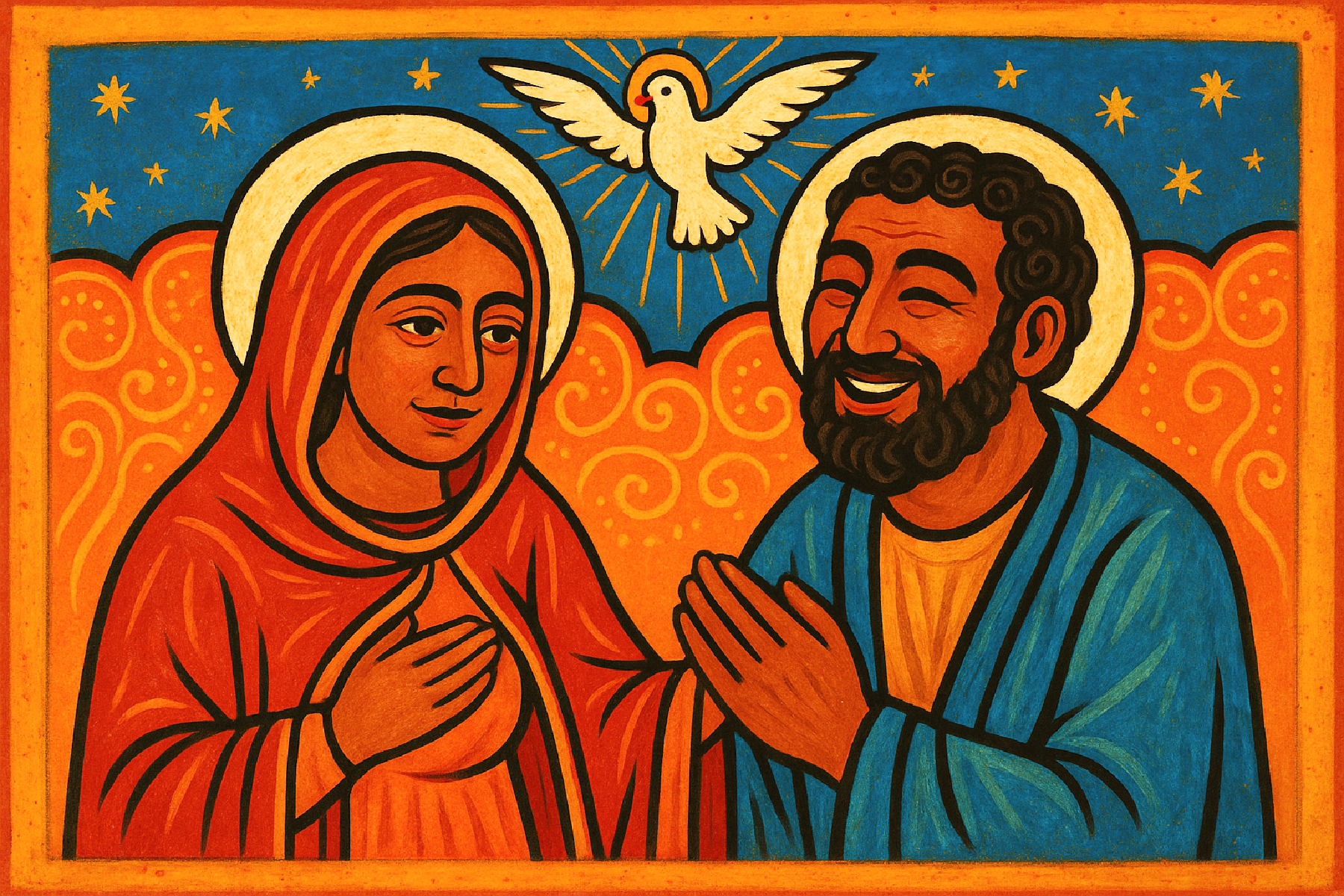
 Before Mary ever heard the angel’s voice, before her yes echoed through heaven and earth, another story had already begun—quiet, steady, shaped by the deep longing of her parents, Joachim and Anne.
Tradition remembers them as a couple who waited much longer than they ever expected for a child. The kind of waiting that settles into the bones, shapes the rhythm of daily life, and teaches you how to hold onto hope in a quieter, steadier way. Not a hope that rushes ahead or demands answers, but a hope that stays with you even when you’re tired—something lived more than spoken, carried more than announced.
So they prayed. Not the bold prayers of people expecting miracles, but the steady prayers of those who have learned to keep showing up even when the heart grows tired. Their hope was not glamorous. It was stubborn. It was tender. It was a hope that grew slowly inside disappointment, watered by faithfulness rather than results. Women and families across generations know this kind of endurance—the kind that is born in kitchens and courtyards, at tables worn by worry, in homes where longing has lived for years.
When the long silence finally broke, it came in the form of a promise. Joachim and Anne were told that their waiting was not wasted. They would have a child—a child whose life would begin in a grace so deep that no shadow of sin would touch her from the first moment of her existence. A child who would one day hear an invitation from God that would reshape the story of the world. A child, Mary, full of grace.
This is the mystery Christians call the Immaculate Conception: grace planted in Mary at the very beginning, preparing her heart before she could speak her name, before she could make a choice, before she could understand her place in the world. The miracle is God’s. The timing is God’s. The grace is God’s.
But the world into which Mary arrived—that belonged to Anne.
Mary grew within the fierce tenderness of a woman who had learned to stand firm when life felt unstable. She inherited her mother’s resilience the way daughters inherit a laugh, a posture, a way of walking through the world. Years of waiting had shaped Anne, deepening her compassion and sharpening her hope. Mary grew up beneath that strength, watching faithfulness manifest gradually, day by day.
Grace begins Mary’s story, yes. But grace does not bypass the ordinary human formation passed from mother to daughter. Mary learned how to trust from a woman stretched by longing. She learned how to listen from someone who had survived seasons when God felt silent. She learned how to stand steady from a mother who had held her ground in the dark.
So when the angel appears years later, Mary’s yes is not spoken from a distance. Her yes carries Anne’s courage, her patience, and her hard-earned belief that God can still move after long seasons of silence, even at the edge of the unknown. Her yes carries a lineage of women who held sorrow and hope in the same hands, who kept the story alive when the world counted them out.
The Immaculate Conception is about God drawing near in the most ordinary, intimate way possible: through a family shaped by longing, through a mother formed by endurance, through a daughter who carries her mother’s strength even as she carries God’s Son.
And God continues to draw near in the places we least expect—through the migrant who crosses borders with only courage, through the worker whose name is forgotten but whose labor holds communities together, through the person dismissed or rejected, treated as if their life matters less. These early Advent days bring back the familiar strains of Handel’s Messiah, music shaped by Isaiah’s haunting vision of the Servant “despised and rejected… a man of sorrows and acquainted with grief” (Isa 53:3). The point is not that the vulnerable carry guilt that is not theirs, but that their lives bring us close to the wounds of the world—wounds we would rather turn away from. Their suffering reveals what our systems conceal. Their endurance exposes truths we prefer not to face.
Migrants share that same nearness to the Cross: not as substitutes for Christ, but as people whose stories uncover the fractures we have learned to overlook. They stand in the very places where injustice shows its teeth. And in their courage, we glimpse the God who chooses the humble, who lifts up the despised, who enters history through families marked by longing, poverty, and unwavering hope.
When the long silence finally broke for Joachim and Anne, it came in the form of a promise. And the same is true now. In the lives of migrants whose futures hang in the balance, in households holding steady through uncertainty, in the hidden strength of women and men who refuse to stand still and speak up for justice—God is already working toward the first light breaking open the night. The promise is on its way. And when it comes, it will bear the unmistakable shape of grace that has been here all along.