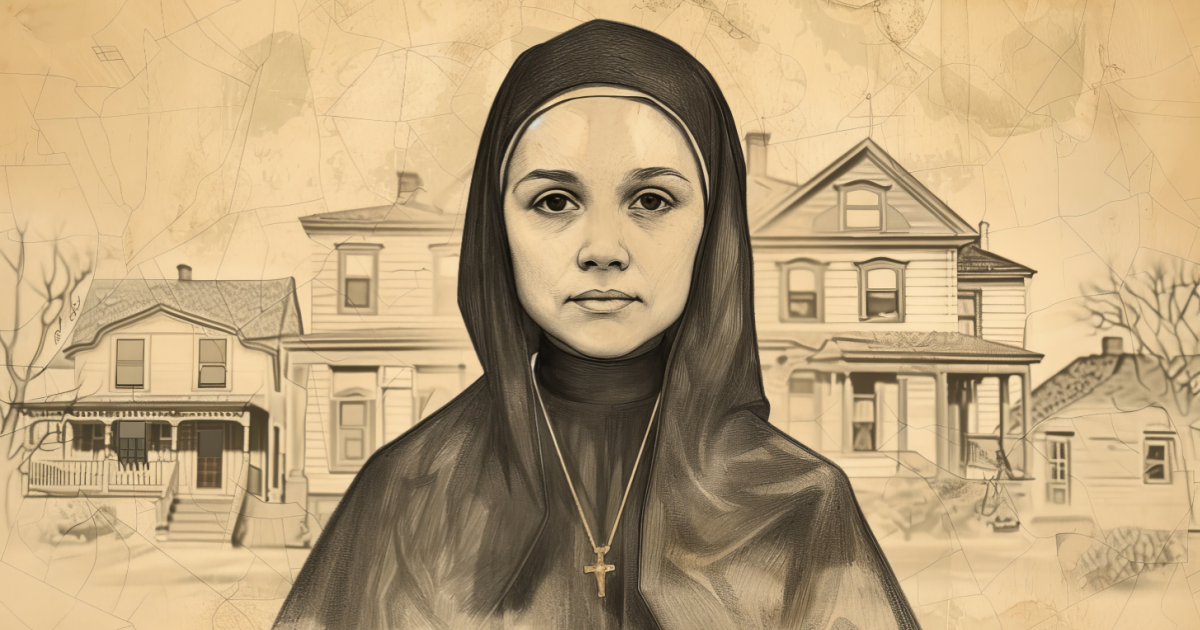
November 13 always sneaks up on me, even when I’m waiting for it. St. Frances Xavier (Mother) Cabrini’s feast day carries a certain weight—a tenderness, a strength, a call to attention.
Mother Cabrini is the patron of immigrants, the saint who crossed oceans with nothing but guts, devotion, and a heart big enough to hold whole neighborhoods. And today, on the day Migrant Christ officially launches, it feels right to stand in her shadow and let her teach us how to begin.
Cabrini had a way of making the Gospel tangible. She didn’t wait for perfect conditions or permission slips. She arrived, looked around, and asked the most Christian question anyone can ask: “Who here is hurting, and how do we love them better?” It wasn’t complicated. It was holy.
But as I prayed leading up to this day, another figure kept coming to mind—a mother who walked her own dusty hill before Cabrini ever boarded a ship. A mother who appeared to a man whose people were being crushed under the weight of empire. A mother who spoke his language and met him on his own ground.
Our Lady of Guadalupe.
Somehow she fits perfectly into this moment, not as a symbol of the past but as a sign for the road ahead. Migrant Christ begins with a simple conviction: that God walks with people on the move. Not from afar. Not as an observer. As a companion. And Guadalupe embodies that truth in a way that transcends borders, centuries, and politics.
 Her story is a story of divine migration—of God choosing to show up among an oppressed people in the imagery, symbols, and skin of their own world. The flowers on her dress carry Indigenous meaning. The stars on her mantle echo the December sky of 1531. Her presence says what every migrant longs to hear: “You are seen. You are held. You are not alone.”
If Mother Cabrini teaches us how to build bridges, Our Lady of Guadalupe teaches us where those bridges should lead.
Together, they frame the heart of this launch day. Cabrini reminds us that faith is not real until it takes shape in movement—accompaniment, advocacy, showing up. Guadalupe reminds us why we move at all: because God always moves toward those who have been pushed aside.
And that is what Migrant Christ is trying to live into.
We begin this work on a day when the Church remembers the woman who boarded boats for strangers, the woman who refused to let immigrants be forgotten, the woman who insisted on dignity long before the world learned the word. And we place this work under the mantle of the Mother who paints the cosmos on her cloak and whispers to every frightened child, ¿No estoy yo aquí, que soy tu madre? [Am I not here, I who am your Mother?]
We could not ask for better company.
So today, as Migrant Christ takes its first official breath, we stand between two women who knew what holy resistance looked like. Two women who understood that presence changes everything. Two women who believed that God walks the road with the weary, and that love—real love—always finds a way through deserts, detention centers, and the closed fists of this world.
We begin with them beside us.
And we begin with hope.