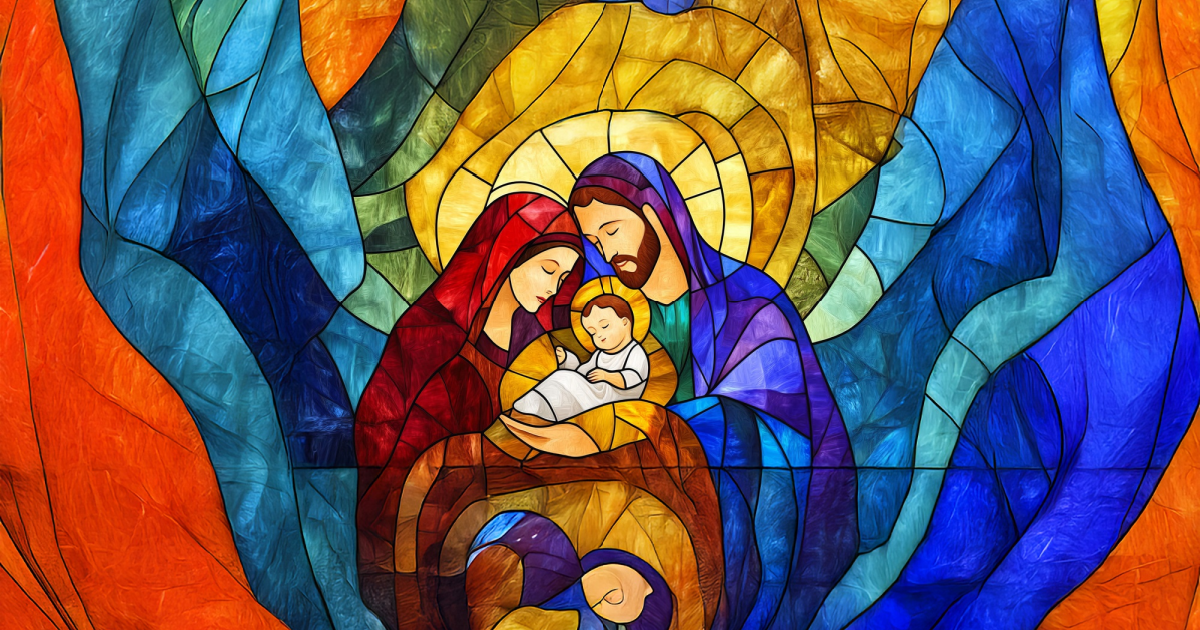
 Christmas does not arrive because the world is perfect. The noise hasn’t died down. Fear still guides decisions. Families remain displaced, and people without criminal records are deported.
Violence continues to take lives. Yet Christmas arrives anyway—not as an escape from reality, but as God’s choice to enter it.
Isaiah depicts a messenger running over the mountains with good news after war and exile (Isaiah 52:7–10). Jerusalem has been destroyed. The people have been scattered. The city lies in ruins. The wounds are still fresh. Nothing is perfect. Yet the message is clear: God reigns. Salvation does not begin with everything restored, but with God’s presence. God does not wait for history to be made whole before stepping into it.
Hebrews presses this claim further (Hebrews 1:1–6). God does not send another instruction or delegate the work to intermediaries. God sends the Son—the Word. Not an idea. Not a system. A person who accompanies us. The Son is the perfect One—fully human and fully divine—through whom God speaks clearly and decisively. God chooses closeness over distance, vulnerability over force.
And John states the mystery plainly: the Word becomes flesh and dwells among us. Not above us. Not safely removed. Among us—inside a body that can be touched, threatened, and wounded, exposed to the same forces that shape every human life (John 1:1–5, 9–14). Christians call this mystery the Incarnation. We might also name it the most glorious migration the world has ever known.
This migration involves genuine risk. The Son takes on a body that can be displaced, wounded, and crucified. Scripture gives this child a name: Emmanuel—God with us—choosing to enter human life in the flesh of the Son. From the beginning, Emmanuel means God on the move—opting for vulnerability rather than safety, proximity rather than power. The Incarnation is not God pretending to be human; it is God binding himself to the human condition.
This is Christmas.
In moments like these, when both the powerful and the humble seem to have lost their way, the instinct is to work harder, organize better, and legislate faster—to believe that if we find the right strategy, we can hold everything together and push the darkness back. But exile has a way of revealing our limits.
Christmas tells the truth about us in moments like this. There are times when cruelty seems better organized than compassion, when fear appears to have the upper hand, and when the weight of history presses down harder than we can carry. We cannot out-organize evil. We cannot legislate our way out of cruelty. We cannot bear the full burden of what has gone wrong on our own shoulders. That is not despair. It is honesty. And Christmas is God’s response to that honesty.
This matters deeply in a world shaped by migration and displacement.
Jesus, the migrant who became flesh, was born under occupation. His family would soon flee violence. They crossed borders to protect his life. From the beginning, God-with-us is bound to movement, risk, and uncertainty. Incarnation does not avoid these realities—it sanctifies them through God’s presence.
To say Emmanuel is not to claim comfort or control. It is to admit our need—for grace we cannot manufacture, for outcomes we cannot guarantee, and for a presence that does not abandon us even when protection cannot be assured.
God with us when systems fail.
God with us when families must choose between staying and going.
God with us when safety cannot be guaranteed in advance.
The Word does not erase darkness. The Word enters it. The light shines, and the darkness does not overcome it—but the darkness remains something to be lived through, not wished away.
Incarnation means God commits to the long work of accompaniment.
God with us—here, now.
Not after things settle down.
Not once safety is guaranteed.
Not when fear loosens its grip.
Here. Now. In flesh. In history. In the middle of what remains unfinished.